 English
 Magyar


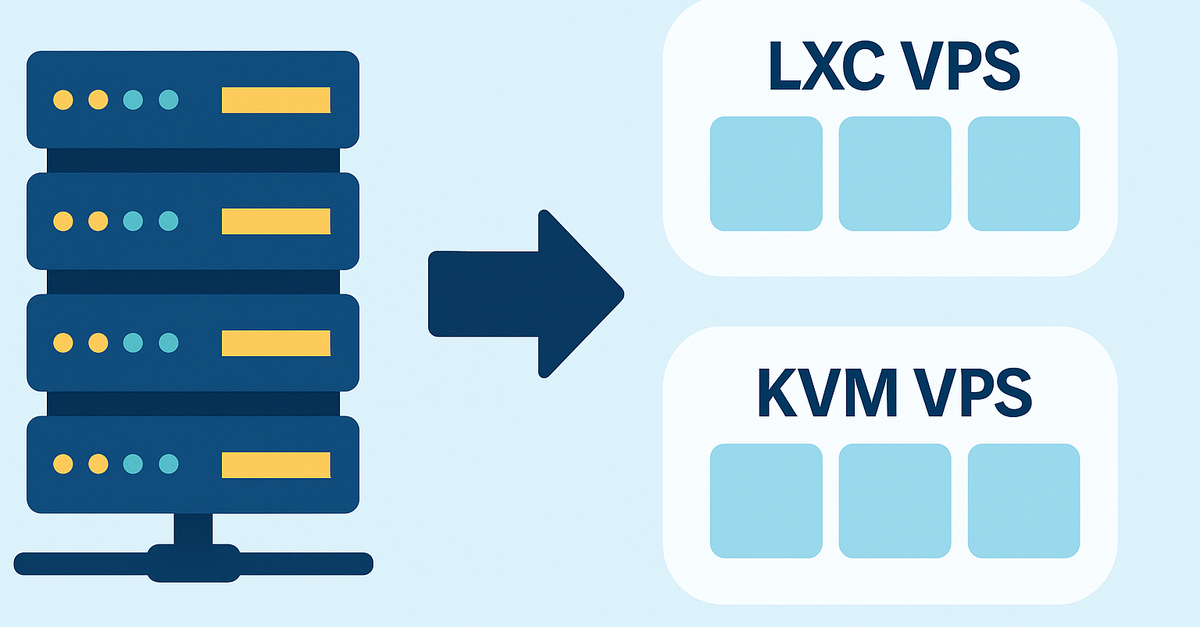
A VPS server, also known as a virtual private server, is simply a high-performance server that is divided into several smaller, but mutually isolated, virtual servers for the purpose of better resource management.
Many people favour VPS hosting because it offers the benefits of dedicated servers without anyone having to rent an entire physical server or set one up themselves.
It is important to note, however, that there are two types of VPS servers:
- LXC VPS
- and KVM VPS.
These represent two completely different virtualisation technologies for servers, so you need to think carefully about which one to choose. In this article, we aim to help you make the right decision by introducing both types!
Everything you need to know about LXC VPS servers
LXC (Linux Containers) is a solution based on virtualisation technology that utilises the Linux kernel’s cgroups and namespaces. This is a container-based virtualisation solution at the operating system level, which generally offers easier and faster start-up times and lower overhead.
As it operates on a container-based system – meaning there is no full virtualisation – it offers much better performance than its counterparts. To explain this in more detail, LXC containers run on the same container as the host machine, meaning they have direct access to all the resources.
Only Linux-based systems can be run on it; in return, however, administration will be easier, and its speed will be further enhanced by its lower resource requirements.
One drawback that is often highlighted is that it is not as isolated as a KVM-based VPS, which can pose a security risk in certain cases; however, with a reputable provider, this need not be a cause for concern.
It is important to note that LXC is not suitable for running Docker directly. The reason for this lies in their functionality: whilst LXC is designed primarily to create and manage virtualised environments, Docker focuses on ease of use and scalability.
An LXC VPS server is the ideal choice if you want to run several identical Linux systems simultaneously, whilst keeping overhead to a minimum.
Everything you need to know about KVM VPS servers
KVM VPS servers offer full hardware-level virtualisation, meaning you can run any operating system on them completely independently of one another – be it Linux, Windows, BSD or anything else.
Virtual servers of this type are capable of significantly higher performance because, as part of the Linux kernel, they provide direct access to both the processor and the memory.
It offers much stronger isolation than LXC, as each virtual machine runs its own kernel, which has a positive impact on both security and stability.
This is an excellent choice if you want to run both Windows and Linux systems on the server at the same time, and high isolation is essential.
LXC or KVM virtual server? Which one should you choose?
Although this may already be clear from the above, it is worth summarising the points made to make it easier to choose between the two types of virtual server, as it is much harder to switch later on, and if you make the wrong decision, you will have to make compromises.
The main difference between the two technologies is that, whilst with LXC virtualisation takes place only at the operating system level, with KVM we are talking about full virtualisation.
In short, an LXC VPS server is recommended if you wish to work in a simple, but exclusively Linux-based environment, do not plan to install or use any other operating system, and, on top of that, are looking for maximum performance.
We always need a KVM VPS server if we want to work with multiple operating systems; for example, if we plan to run a Windows server alongside Linux, or if we are already working with one, and we also insist on strong isolation.
What else should we look out for when choosing the right VPS server?
Simply deciding which type of VPS server we need is not enough in itself! It is extremely important to take the following factors into account, alongside maximum availability:
- Scalability: Scalability is also a key consideration when it comes to VPS servers – and it needs to be easy to achieve. For this reason, you should choose a provider that guarantees this, as the lack of it can cause serious headaches.
- DDoS protection: For all server types, including VPS, it is extremely important to have DDoS protection – as well as other security solutions – to safeguard our servers against, amongst other things, overload-based attacks.
- Backups: Free backups can be a huge help should a problem arise on the server, as they allow you to restore the system to a previous, working state with just a few clicks.
- Extensive Linux support for LXC VPS: If you’ve opted for an LXC VPS server, it’s important that your provider offers extensive Linux support, meaning that all distributions can be installed quickly, easily and without any issues.