 English
 Magyar



In 2012, the Internet Corporation for Assigned Names and Numbers (ICANN) launched its program for new generic top-level domains (new gTLDs) with a view to expanding the domain name space. TLDs form an important part of web addresses and consist of the letters following the dot in a domain name.
TLDs that do not refer to a specific country or territory are known as generic TLDs (gTLDs), such as .com, .net and .org. However, in order to promote innovation, competition and consumer choice, new gTLDs have been introduced. Since the program began, more than 1,200 new gTLDs have been created: some of the most recent include .kids, .music and .spa.
But just how popular are these new gTLDs, and how are they being used?
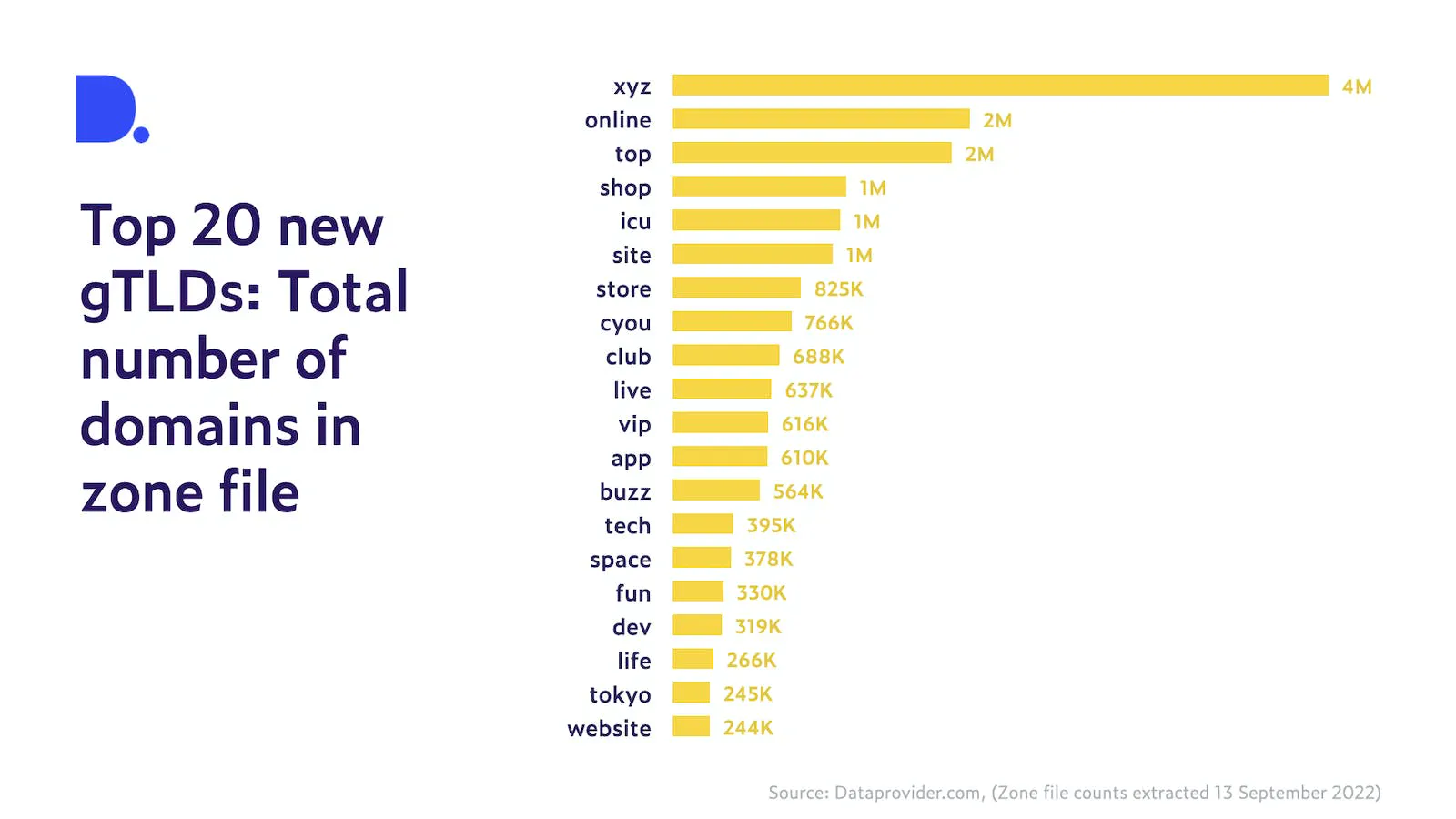
To answer these questions, let’s first look at the top-level domains with the most domains registered in the relevant zone files. In first, second and third place are .xyz (4 million), .online (2 million) and .top (just under 2 million).
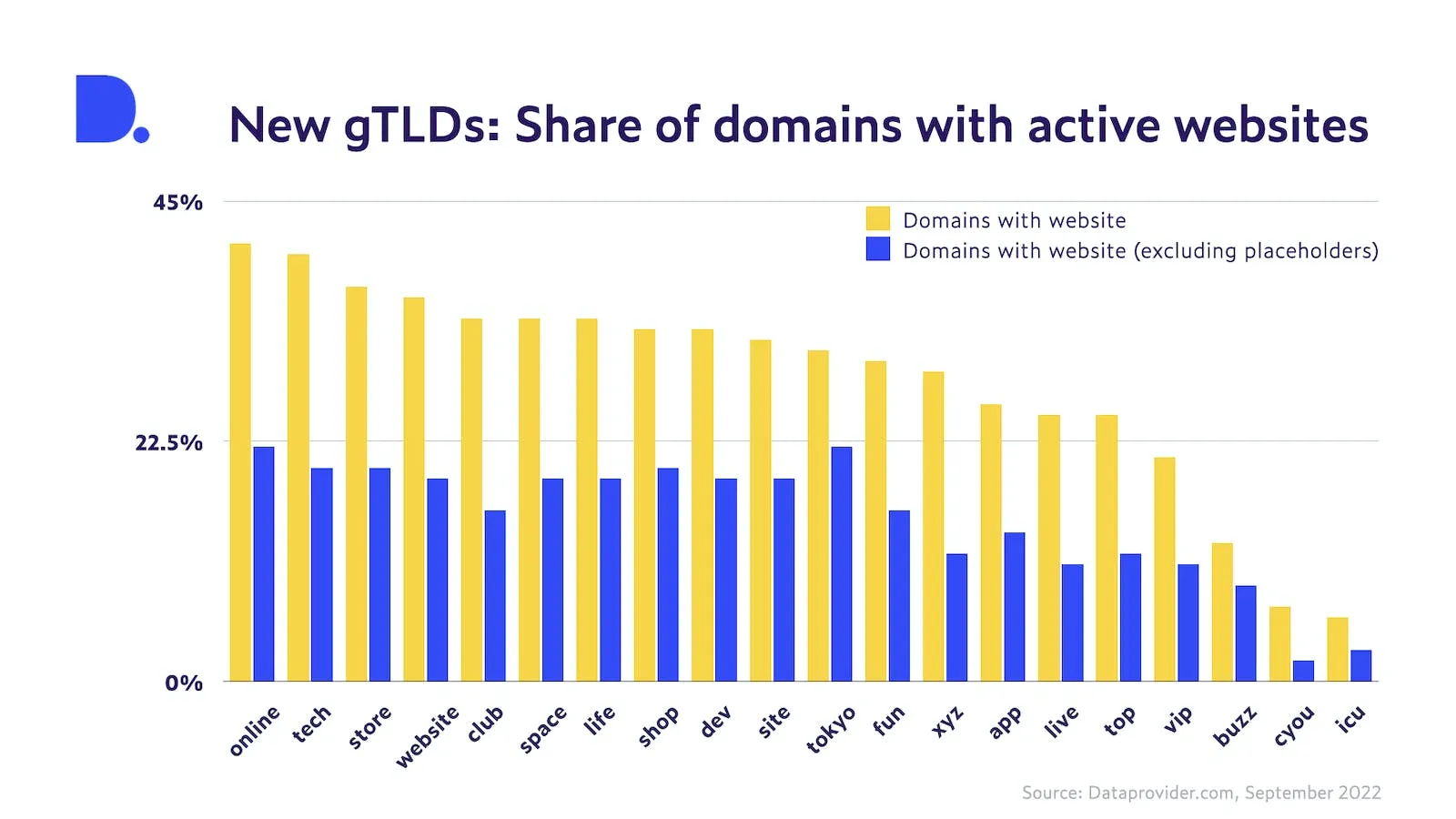
However, if we look only at the number of domains listed in the zone file, it is not clear whether the domain is actually linked to an active website. If we look at the percentage of domains linked to active websites, we see that amongst the largest new gTLDs, .online, .tech and .store have the highest figures: 41 per cent, 40 per cent and 37 per cent of domains, respectively, lead to active websites.
If we take it a step further and now exclude sites such as proxy servers and parked domains, there is another shift in the rankings: whilst .online and .store remain in the top three, .tokyo moves up to second place, accounting for 22 per cent of domains pointing to active websites, which likely means sites with unique content or business websites. At the bottom of the list of the 20 largest new gTLDs are .buzz, .icu and .cyou. For these new gTLDs, fewer than 13 per cent of domains are linked to an accessible website. At the very bottom of the list, only 2 per cent of the domains listed in the .cyou zone file lead to active or ‘placeholder’ websites.
As the number of active websites alone still says little about how often these sites are visited, we’ve gone one step further and looked at our proprietary Traffic Index metric. The Traffic Index is a metric in which we compare a website’s traffic to that of the www.google.com site. Below, we present the proportion of domains with little or no traffic (A), moderate traffic (B) and high traffic (C).
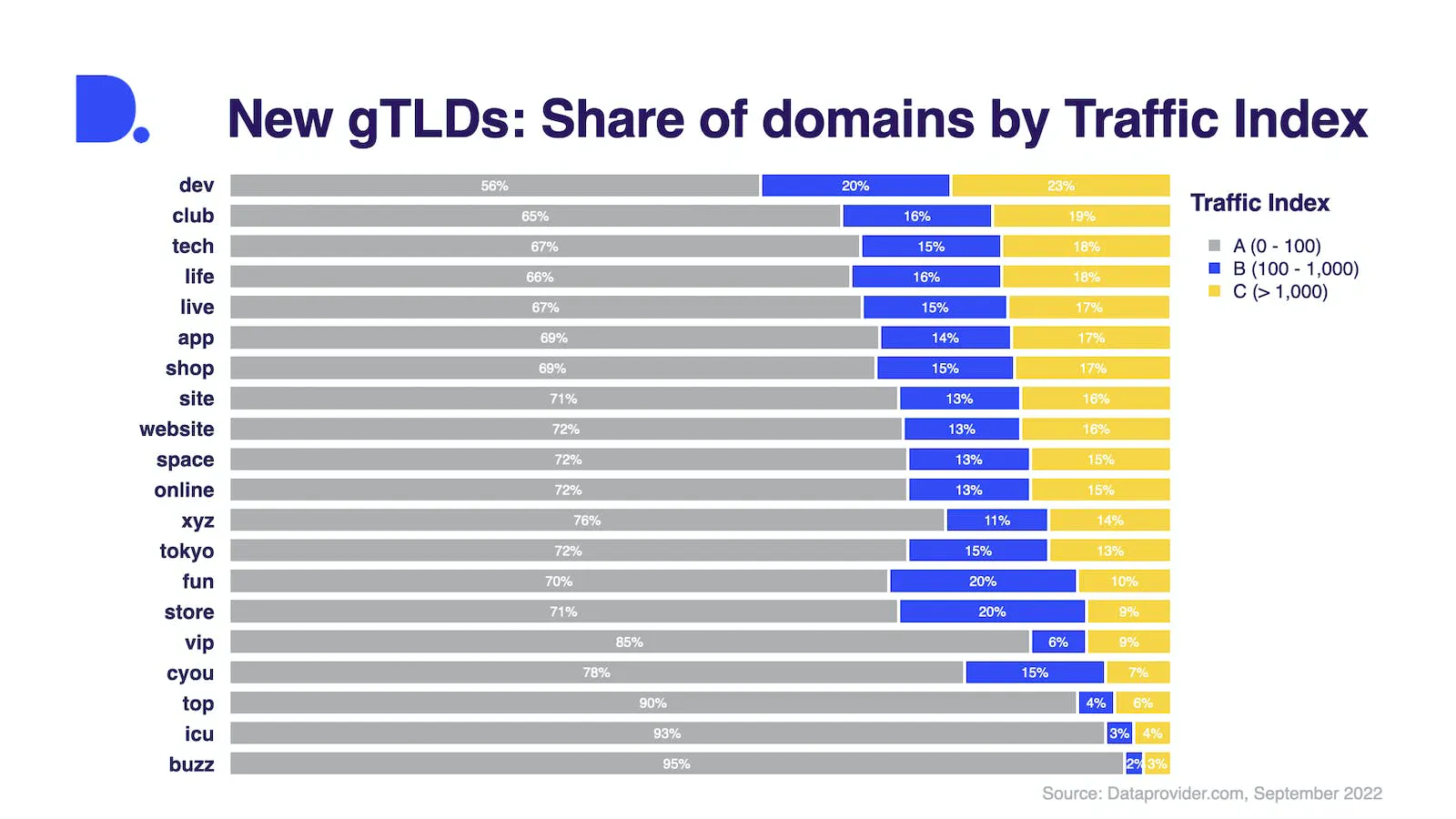
Here we can see that .dev, .club and .tech are the new gTLDs with the highest proportion of frequently visited domains. New gTLDs related to e-commerce, such as .store and .shop, also show a relatively high proportion of domains with medium and high traffic indices. As might be expected from the results above, the proportion of domains with medium and high traffic is lowest amongst .icu and .buzz domains.
Our analysis of the top 20 new gTLDs, based on the number of domains registered in the relevant zone file, shows that the number of registrations does not necessarily reflect the number of active websites. To gain a true picture of how these new gTLDs are being used and how popular they are, further factors must be taken into account. If the aim of these new gTLDs is to foster innovation and increase competition, then a better understanding of the types of websites associated with a given new gTLD, as well as the traffic attracted by these domains, can help assess the true impact of these new additions.