 English
 Magyar



Whilst the .com extension originally derived from the word ‘commercial’ and was intended for commercial websites and businesses, today it is used by all kinds of websites, beyond just those with a commercial focus. To better understand how the .com domain is currently used, let’s first look at the response returned by a given hostname. Of the more than 160 million registered websites, approximately 40 per cent are accessible, whilst the remaining 60 per cent either redirect (15 per cent), deny access (29 per cent) or are undetectable (16 per cent), which means that the domain name has no registered NS servers or no A record – so the domain name is simply parked.
If the website is accessible, we classify it into different types based on its content and purpose, such as e-commerce (a website where products can be purchased) or a placeholder (a website provided by the registrar that contains no content).
As shown below, around a quarter of .com websites are classified as parking sites, and almost as many domains are used for business purposes. Websites with content make up the largest proportion (33 per cent).
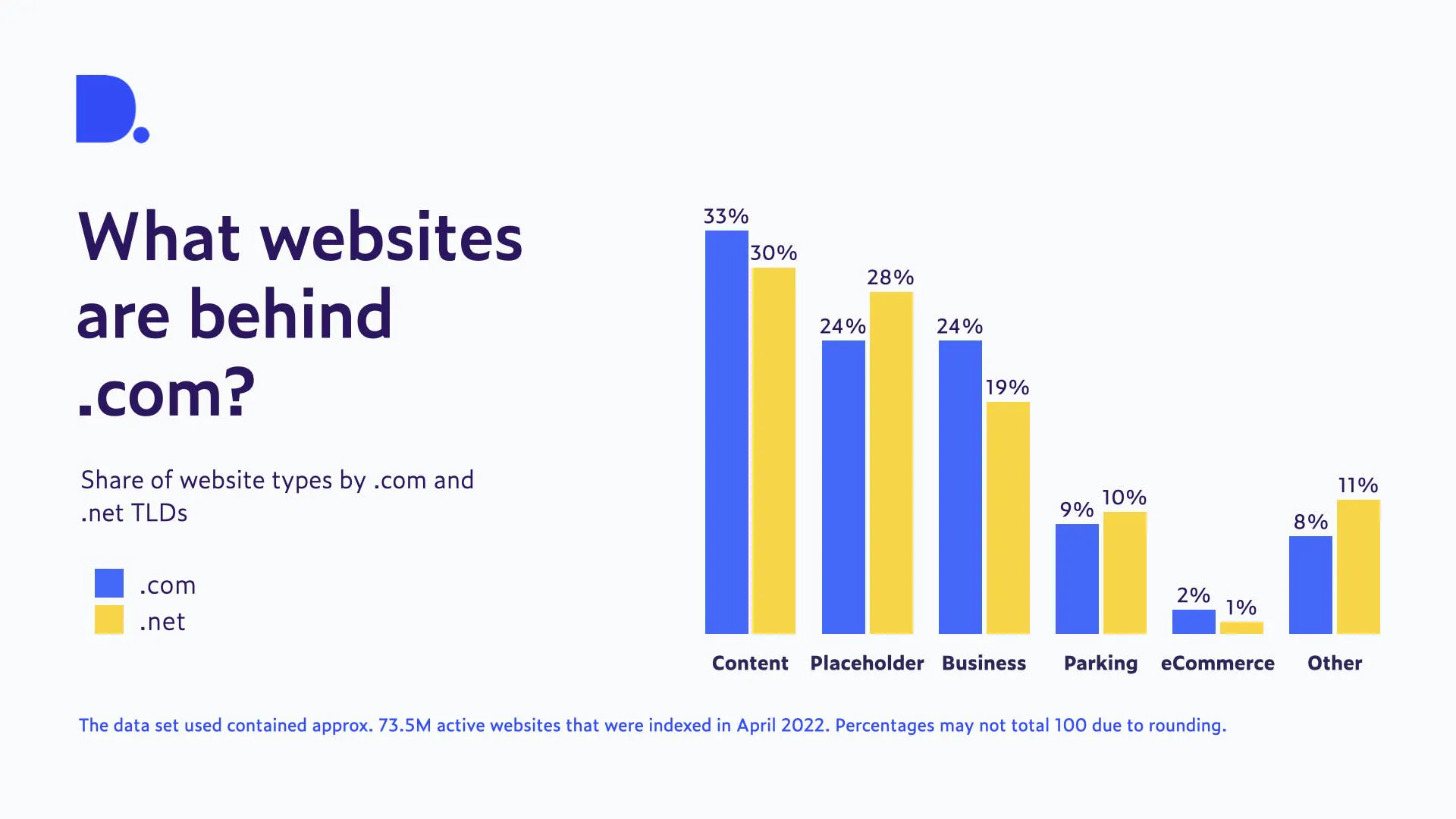
If we compare this with the .net domain, we see a similar distribution, although there are slightly more parked (28 per cent) and fewer business (19 per cent) domain names. Furthermore, more e-commerce websites have been registered under the .com domain than under .net (2.4% vs. 1.0%), which suggests that the .com TLD is retaining its original ethos, namely targeting commercial enterprises.