 English
 Magyar



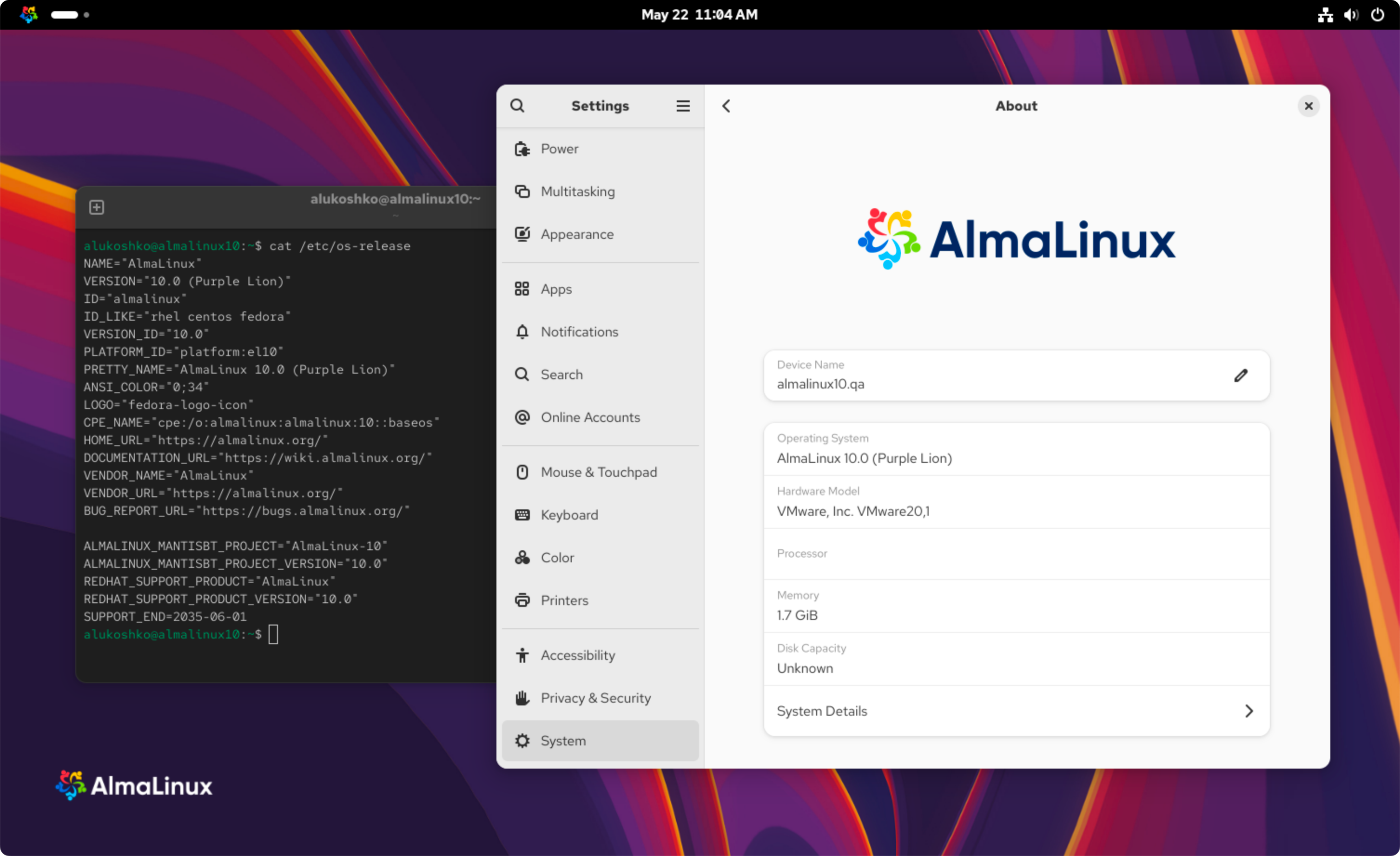
On 27 May 2025, the AlmaLinux OS Foundation announced the general availability of AlmaLinux OS 10.0, codenamed ‘Purple Lion’! The new major release uses the 6.12.0-55.9.1.el10_0 kernel and is compatible with Red Hat Enterprise Linux 10.
🚀💜🦁 AlmaLinux OS 10.0 codenamed “Purple Lion” is now GA!
— AlmaLinux (@AlmaLinux) May 27, 2025
Here's what it brings ⬇️
- Frame pointers are enabled by default
- Secure Boot for Intel/AMD and ARM platforms
- SPICE support is fully re-enabled
+ more!https://t.co/feXOPEgN5g
The installation ISOs are available via the links below:
From version 10.0 onwards, there are no longer any 32-bit (i686) packages, so the compatibility libraries required to run old 32-bit programs are not installed either. (In version 10.2, the i686 user packages have returned.)
The aim of AlmaLinux OS is to support the community, and AlmaLinux OS 10 is the best example of this to date. In an effort to maintain compatibility with Red Hat Enterprise Linux (RHEL), minor enhancements have been made to AlmaLinux OS 10, which are aimed at a specific group of users. These are intended for users who need them and know how to use them. AlmaLinux OS users who expect RHEL compatibility will be pleased to know that AlmaLinux 10, like its predecessors, is fully compatible with RHEL 10.
As mentioned previously, AlmaLinux OS 10.0 is based on the completely new upstream release, AlmaLinux OS Kitten. If you’ve been following the discussions of the ALESCo (AlmaLinux Engineering Steering Committee), you’ll know that Kitten has introduced a host of new features that the community needs.
Supporting developers by enabling frame pointers
For software developers, frame pointers are essential for diagnosing and optimising applications. For those using AlmaLinux as their base system, the default absence of frame pointers posed a problem, but the AlmaLinux team has now resolved this.
Framework metrics are enabled by default in AlmaLinux OS 10. This enables system-wide real-time monitoring and profiling to optimise the performance of any workload running on AlmaLinux.
Extended x86-64-v2 support period
Within the x86-64 architecture, there are versions that support specific CPU features. In RHEL 10, Red Hat only supports x86-64-v3 and later versions, which means that a number of fully functional CPUs will not be supported within the Enterprise Linux ecosystem.
AlmaLinux OS 10 follows Red Hat’s decision to ship binaries optimised for x86-64-v3 by default, whilst also providing an additional x86-64-v2 architecture, which allows users running on older hardware to receive security updates for a further 10 years. According to the release notes, the v2 version is suitable for tasks where the base package set is sufficient, or where the user can recompile additional packages themselves.
To check which level a processor supports, you can use the dynamic linker on an existing Linux system running glibc 2.33 or later (for example, AlmaLinux 9):
/lib64/ld-linux-x86-64.so.2 --help | grep supported
If the output includes the line x86-64-v3 (supported, searched), the standard x86_64 ISO will also run; if only v2 is supported, choose the x86-64-v2 ISO.
Renewing the EPEL lifecycle for x86-64-v2
By default, EPEL follows Red Hat’s builds, which means that all third-party packages for RHEL10 will be built for x86-64-v3. As AlmaLinux announced a week earlier, with ALESCo’s approval, EPEL 10 packages will also be compiled for x86-64-v2 to support users in the roll-out of the AlmaLinux OS 10 x86-64-v2 release.
Secure boot for ARM platforms
Secure boot has long been a requirement for bare-metal devices and is becoming increasingly popular in virtualised environments too. AlmaLinux OS 10 supports secure boot on Intel/AMD and ARM platforms.
Adding SPICE
The Simple Protocol for Independent Computing Environments (SPICE) has not been supported since RHEL 9.0. AlmaLinux users have requested that support be reinstated, so SPICE support has been fully re-enabled in AlmaLinux OS 10 for both server and client applications.
KVM technical preview for IBM POWER
AlmaLinux OS 10.0 includes a technical preview of KVM virtualisation support for the IBM Power architecture. This has not been available in the upstream since version 9.0, but is essential for many AlmaLinux users. The list includes the Oregon State University Open Source Lab, which submitted the RFC to the AlmaLinux Engineering Steering Committee for consideration in February.
Extended hardware support continues
From AlmaLinux versions 8.10 and 9.4 onwards, support for more than 150 devices that had been removed by the upstream project has been re-enabled. These additions continue in AlmaLinux OS 10.0: the aacraid, be2iscsi, be2net, hpsa, lpfc, megaraid_sas, mlx4_core, mpt3sas, mptsas, qla2xxx and qla4xxx drivers now recognise older controllers once again. You can find the full list of devices in the AlmaLinux OS 10.0 release notes.
Software versions in AlmaLinux 10.0
With the new major release, almost every key component has taken a significant step forward compared to version 9:
| Area | Versions |
|---|---|
| Languages | Python 3.12, PHP 8.3, Node.js 22, Ruby 3.3, Perl 5.40 |
| Web servers | Apache HTTP Server 2.4.62, nginx 1.26 |
| Proxy and cache | Varnish Cache 7.6, Squid 6.10 |
| Databases | MariaDB 10.11, MySQL 8.4, PostgreSQL 16, Valkey 8.0 |
| Version control | Git 2.47, Subversion 1.14 |
| Basic toolchain | GCC 14.2, glibc 2.39, binutils 2.41 |
| Compilers and toolkits | LLVM Toolset 19.1.7, Rust Toolset 1.84.1, Go Toolset 1.23 |
| Troubleshooting and performance monitoring | GDB 14.2, Valgrind 3.24, SystemTap 5.2, PCP 6.3.2, Grafana 10.2.6 |
An important change for web server operators is that Valkey 8.0 has replaced Redis; Valkey is the open-source, community-driven successor to Redis. Most applications can connect to it without any changes, but the package and service names (valkey) must be updated in the installation scripts.
Security updates
- Post-quantum encryption: crypto-policies, OpenSSL and OpenSSH already support post-quantum (PQ) algorithms
- OpenSSH 9.9 replaces OpenSSH 8.7 in AlmaLinux 9
- Sequoia PGP: the
sqandsqvtools alongside GnuPG - OpenSSL: FIPS-compliant PKCS #12 files and
pkcs11-providerfor hardware tokens - SELinux 3.8 and Keylime agent 0.2.7 (default TLS 1.3, new
keylime-policytool) - sudo system role: sudo settings can be managed centrally using Ansible
Installation and checking the ISO
The packages and repositories for AlmaLinux 10 are signed with a new key: RPM-GPG-KEY-AlmaLinux-10. You can verify the downloaded ISO, regardless of architecture, as follows:
wget https://repo.almalinux.org/almalinux/RPM-GPG-KEY-AlmaLinux-10
gpg --import RPM-GPG-KEY-AlmaLinux-10
wget https://vault.almalinux.org/10.0/isos/$(uname -m)/CHECKSUM
gpg --verify CHECKSUM
sha256sum AlmaLinux-10.0-$(uname -m)-boot.iso
The output of gpg --verify should include the line ‘Good signature’ from the ‘AlmaLinux OS 10’ key (fingerprint: EE6D B7B9 8F5B F5ED D9DA 0DE5 DEE5 C11C C2A1 E572), and the ISO’s SHA256 value must match that in the CHECKSUM file.
Upgrade to AlmaLinux 10
Users of the 10.0 beta can update to the final release as follows:
dnf install https://repo.almalinux.org/almalinux/almalinux-{release,repos,gpg-keys}-latest-10.$(uname -m).rpm
dnf upgrade -y
The dnf upgrade command will not upgrade you from AlmaLinux 9 to 10. Upon release, AlmaLinux indicated that support for version 10.0 was under development as part of the ELevate project; it is worth checking the conditions for in-place upgrades and the currently supported paths at the end of our ELevate guide and in the ELevate documentation. In many cases, it is simpler to install a new AlmaLinux 10 server and migrate the applications to it.
How long will AlmaLinux 10 be supported?
Active support for AlmaLinux 10 will continue until 31 May 2030, with security updates provided until 31 May 2035. Individual point releases will reach the end of their lifecycle upon the release of the following versions; further releases in the 10 series will be AlmaLinux 10.1 (November 2025, with Btrfs support) and AlmaLinux 10.2 (May 2026). The previous major version, AlmaLinux 9, will receive security updates until 2032, whilst AlmaLinux 8 will receive them until 2029; the latest release in the 9 series is 9.8.
You can read the full release notes for this version on the wiki: AlmaLinux OS 10.0 release notes, and the full list of changes in the Red Hat Enterprise Linux 10.0 release notes.
AlmaLinux is also an available operating system option on our KVM VPS servers. The x86-64-v2 version is particularly useful if you wish to run version 10 on a dedicated server with an older processor.