 English
 Magyar


If you’re new to the World Wide Web, or aren’t very familiar with how it works and the terminology involved, you might think that the World Wide Web consists solely of web pages. Obviously, it’s a bit more complex than that. In our series on internet basics, we explain some of the fundamentals, and today we’re looking at what you type into your browser. Language is important, and even here at Dataprovider.com, where we deal with everything related to the web on a daily basis, we still sometimes get confused: what is a domain? What is a hostname? Should I call it a website, a hostname or a domain?
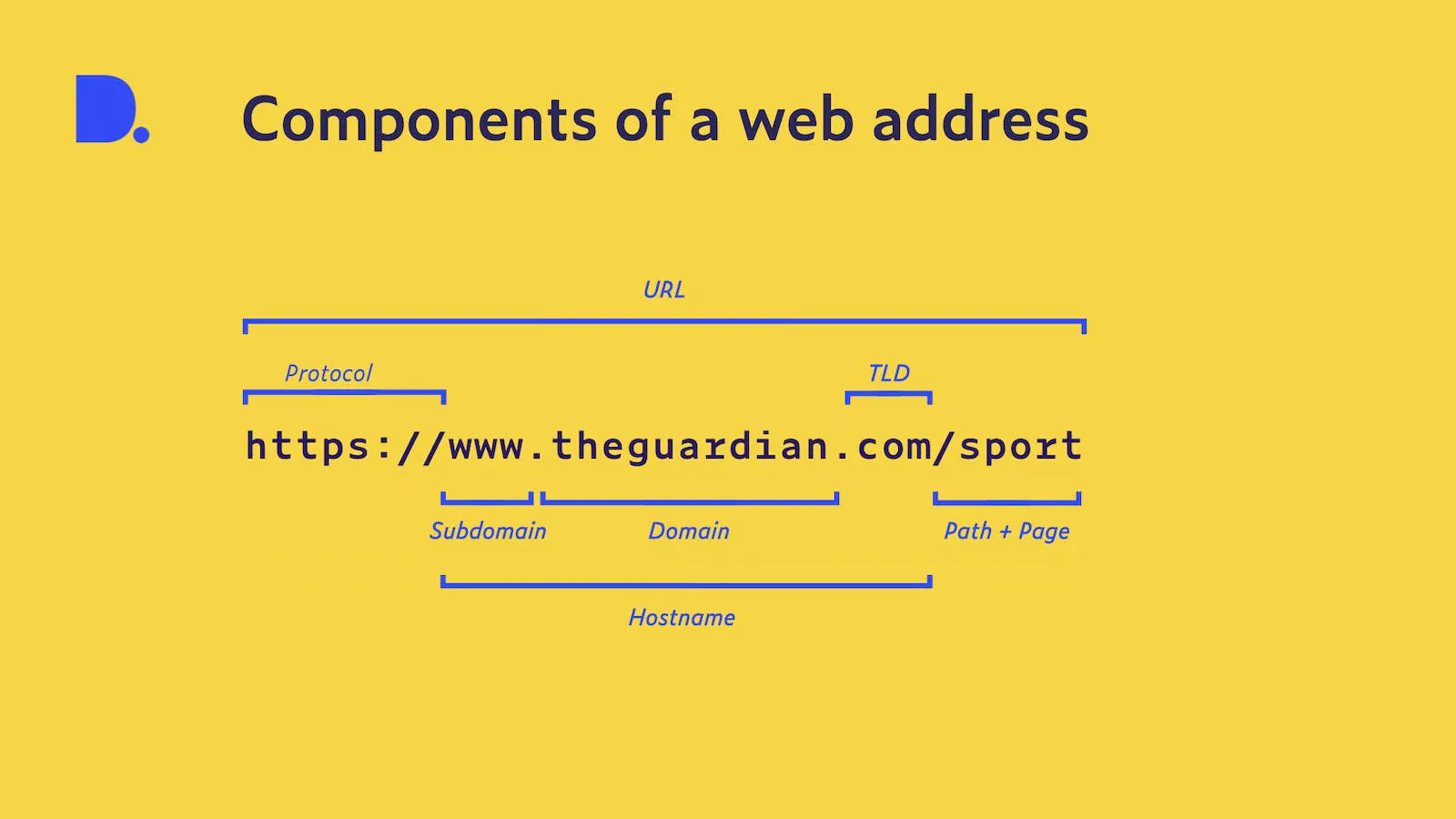
So let’s take a look at what appears at the top of the browser when we visit a website. This is known as a Uniform Resource Locator (URL). A URL usually begins with the protocol (http or https), followed by the subdomain (e.g. www or shop), then the domain, which is followed by the top-level domain (TLD; e.g. .com or .de). The subdomain and the domain together form what is known as the hostname.
Subdomains
Let’s look at subdomains first. As a website owner, you can usually choose what text to use as a subdomain. A single subdomain label can be up to 63 characters long, but you can use multiple subdomains (e.g. blog.shop.wildthings.com) as long as the full hostname does not exceed 255 characters.
Subdomains are often used to test a version of a website. These websites can then be used to trial new plugins or updates before they are published. Subdomains are also commonly used to separate a website’s mobile versions (m.etsy.com), region-specific sites (usa.website.com) and sub-sections of a website (blog.website.com).
Another popular way to use subdomains is to set up e-commerce businesses using subdomains such as ‘store’, ‘shop’, ‘boutique’, ‘tienda’ and so on. An e-commerce website often requires additional features, such as the facilitation of financial transactions, so it is worth setting up these pages on separate subdomains.
The most common subdomain is ‘www’, followed by variants such as ‘ww1’, ‘ww38’ and so on. Among subdomains using full words, ‘blog’, ‘shop’, ‘store’, ‘work’ and ‘job’ are popular, but literally anything can be a subdomain; for example, in our data we also come across subdomains such as ‘covid’, ‘discuss’ and ‘gifts’.
Domains
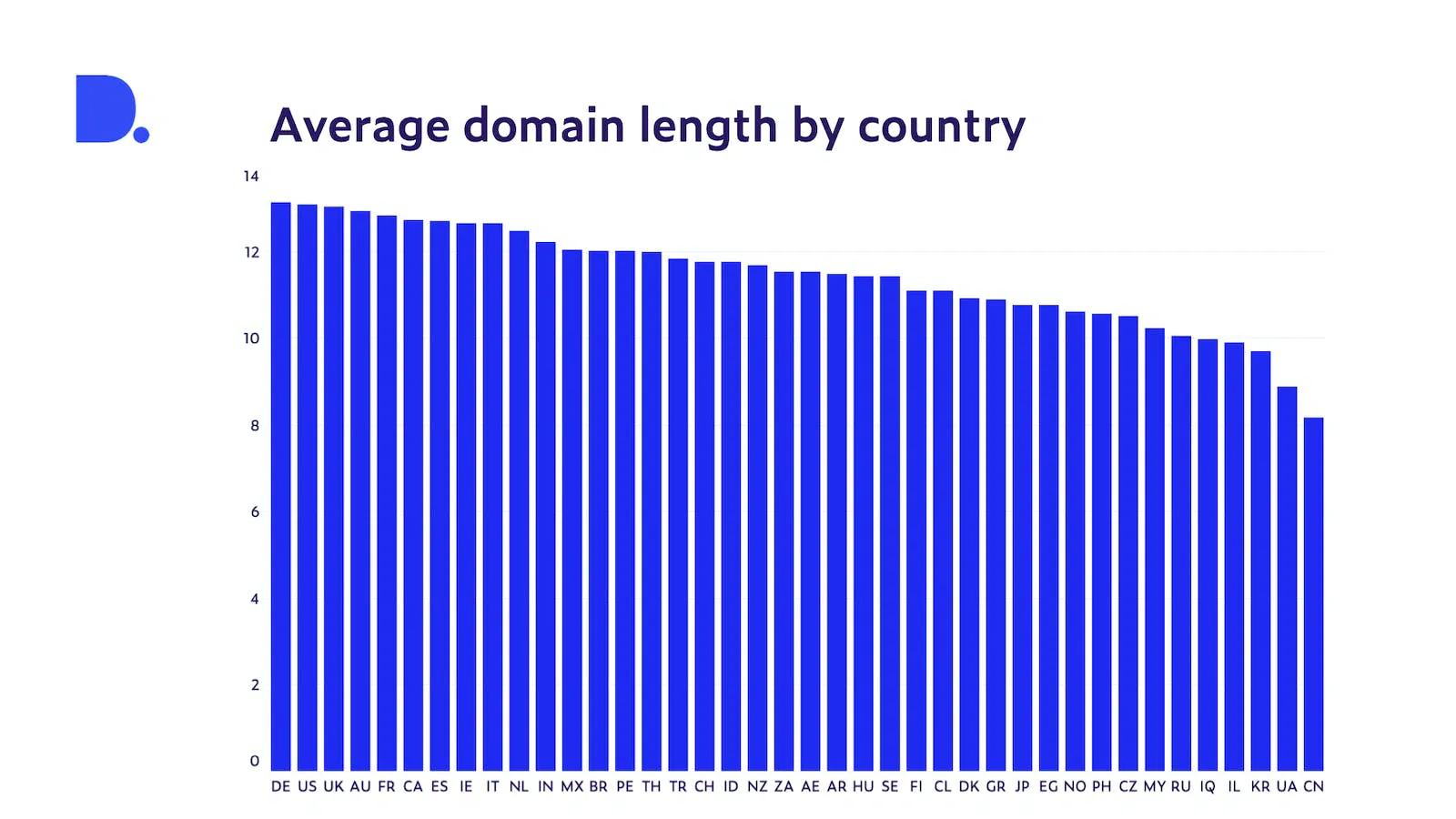
A domain is what you register: a unique name that you choose for your website. A domain can be just one character (e.g. b.fit), but it cannot usually be longer than 63 characters (e.g. queensnybedbugsroachantstermitesmiceratspestcontrolexterminator.com). We took a closer look at which country has the longest average domain length based on the number of characters. Among the 51 countries included in the research, the average domain length ranges from 8.2 (China) to 13.1 (Germany). The Germans are famous for forming incredibly long words simply by combining nouns, so it is perhaps not surprising that, on average, their domain names are also the longest. In China, numbers often feature in domain names as they are considered to bring good luck; nearly 50 per cent of the domains in the databases containing at least one number are Chinese, which may explain the shorter domain names.
Top-level domains
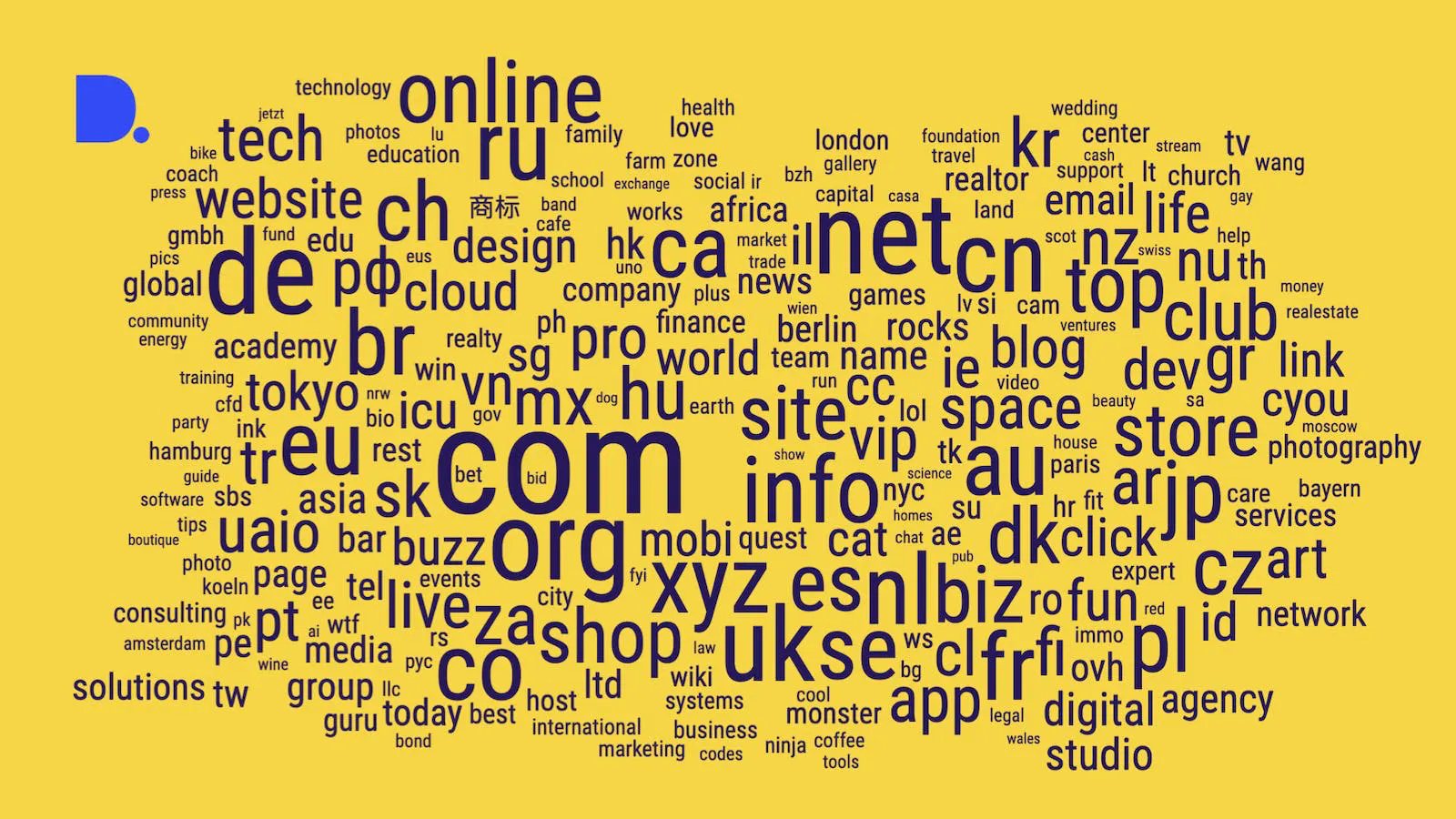
Top-level domains (TLDs) are the letters entered after the domain name. TLDs can be divided into generic TLDs, such as com, net, org, biz and info, and country-code TLDs, such as ik, de, nl, cl, au, etc. In addition to these, new generic TLDs have also appeared over the years, such as ‘xyz’, ‘travel’ and ‘community’, as well as geo-TLDs such as ‘london’, ‘tirol’ and ‘nyc’ (we have previously written about cities and new TLDs).
Our data, which focuses on currently active websites, clearly shows that by far the largest TLD is .com (the abbreviation for commercial domains), followed by the country-code top-level domain .de, and then .net, .org, .uk, .cn and .ru.
Hopefully, this post has helped you better understand the different parts that make up a web address, and you now know the difference between a domain and a hostname. Of course, if you need to decide which domain name to choose and which TLD might be right for you, here’s some information on average length and which are the largest TLDs. The question is: do you want to stand out or blend in?